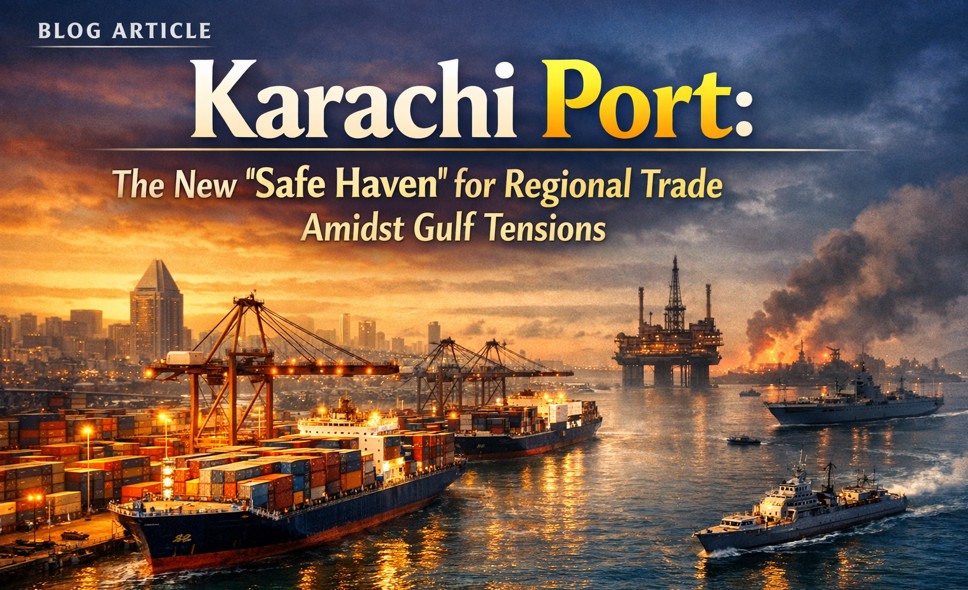
The geopolitical landscape of April 2026 has fundamentally altered global shipping lanes. With the Strait of Hormuz effectively restricted due to the escalating conflict involving Iran, Pakistan’s maritime infrastructure—specifically Karachi Port (KPT) and Port Qasim—has become the primary "Safe Haven" for regional cargo.
In a historic shift, Karachi handled more transshipment volume in the first 24 days of March 2026 than it did in the entire year of 2025. This surge is driven by shipping lines seeking to avoid high-risk zones and the four-fold increase in insurance premiums for vessels entering the Persian Gulf.
Impact of Regional Tensions on Logistics:
Transshipment Boom: Major liners like MSC, Maersk, and Hapag-Lloyd are increasingly "dropping" UAE and Gulf-bound cargo at Karachi for temporary storage and subsequent feeder redistribution.
The "War-Risk" Surcharge: Exporters and importers are navigating a new financial reality. Emergency Contingency Surcharges (ECS) and war-risk premiums now range between $3,500 and $4,000 per TEU, significantly raising the landed cost of goods.
Energy Security: With 80% of Pakistan’s crude imports traditionally transiting the Hormuz chokepoint, the industry is pivoting toward alternative sourcing and strategic stockpiling to mitigate supply chain bottlenecks.
Current Market Rates & Conditions (April 2026):
Average Freight (Subcontinent to West Africa/Europe): Seeing "Emergency Freight Increases" of roughly $0.70/kg for air and significant ocean hikes.
Port Productivity: Karachi terminals (KGTL/SAPT) are operating 24/7, even during holidays, to manage the 11,000+ TEU monthly transshipment influx.
Regulatory Facilitation: The government has fast-tracked the use of "off-dock" terminals at Mauripur and Port Qasim to prevent congestion at the main berths.
Outlook:
Industry experts predict that even if a permanent ceasefire is reached tomorrow, the restoration of traditional shipping patterns will take at least 3–5 months. For the remainder of Q2 2026, Karachi will remain the pivotal gateway for the region.
Recommendation for Traders:
Logistics managers should prioritize transshipment-friendly ports like Karachi to avoid the volatility of the inner Gulf. Additionally, ensure all contracts account for the latest "War-Risk" transparency agreements reached between shipping lines and trade bodies in early April.
Contact us to navigate these complex routes. We provide specialized logistics solutions for FCL/LCL cargo looking for secure, cost-effective passage during these turbulent times.